
Technical articles and case studies
Professional two-way radio systems compared with PoC radios
Professional two-way radio systems operate independently of public cellular networks, providing reliable real-time emergency and operational communications. This guide covers narrowband radio architecture, licensing in China, and how dedicated radio systems compare with push-to-talk over cellular (PoC).
1. Overview
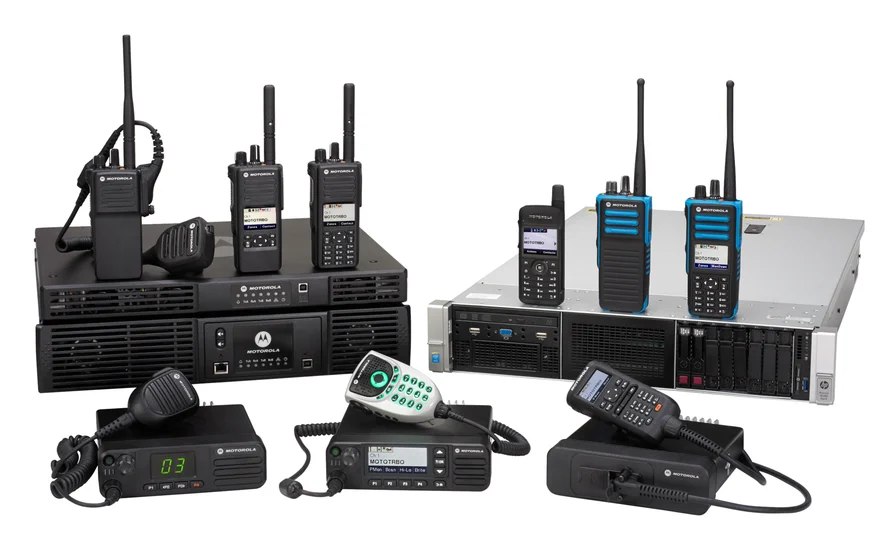
Dedicated two-way radio is a proven wireless communications technology valued for high reliability and stability. Because the system operates independently without relying on any external public network, it serves as a vital backup for emergency communications when public networks become congested, fail, or are disrupted during disasters—acting as a last line of defense for safeguarding assets and life safety.
Commercial two-way radio systems operate primarily in the UHF band (used in Shenzhen, while VHF is widely used in several other parts of China). The UHF band corresponds to a 70 cm wavelength, which propagates efficiently across urban building floors and enables instant, zero-delay one-to-many voice communication.
In China, radio spectrum is regulated under the Regulations of the People's Republic of China on Radio Administration, the Provisions on the Administration of Radio Transmission Equipment, and the Regulations of the People's Republic of China on Radio Frequency Allocation. Oversight is handled by the Ministry of Industry and Information Technology (MIIT) and provincial or municipal departments of industry and information technology. Except for license-free low-power FRS radios operating on designated 409 MHz frequencies, all radio equipment—including enterprise two-way radios and repeater systems—requires prior frequency authorization followed by a radio station license before deployment.
2. Dedicated two-way radio systems
Once an organization obtains frequency authorization and a radio station license, two-way radios provide instant one-to-many dispatch well suited to internal operational management.
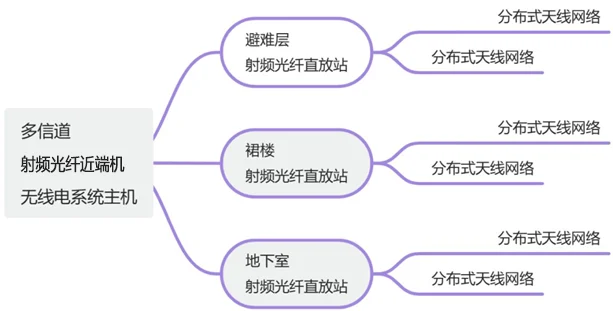
In dense urban environments, proliferation of mobile phones, cellular base stations, Wi-Fi, and Bluetooth increases RF congestion and interference, reducing transmission efficiency. Inside buildings—particularly enclosed rooms and basements—reinforced concrete and steel structures further attenuate radio signals, limiting direct-mode range. To achieve seamless coverage inside and around buildings, organizations typically deploy a repeater paired with an indoor distributed antenna system (DAS).
2.1 Basic radio system architecture
2.2 Independence
A dedicated radio system operates autonomously, isolated from telecom carrier networks, and supports 24/7, 365-day continuous operation. Once deployed according to coverage design, any portable radio within the covered interior or perimeter can initiate instant calls.
2.3 Operational resilience
Because the radio network is self-contained, outages, maintenance upgrades, congestion, or disaster-related failures on public telecom networks do not affect it. Teams maintain reliable voice contact at critical moments.
2.4 Reliability
Designed for continuous 24-hour duty, repeater infrastructure connects to uninterruptible power supply (UPS) systems and supports backup batteries so communications stay online during grid power failures. Focusing cleanly on voice dispatch avoids interference from unrelated service modules and enhances overall stability.
2.5 Cost effectiveness
A dedicated radio system requires a one-time capital investment and typically operates for 5–10 years under routine maintenance. Both infrastructure and portable radios are owned outright without recurring annual airtime or platform fees, lowering long-term operating costs.
2.6 Essential role in modern facilities
Across commercial real estate, property management, and high-tech manufacturing facilities, a dedicated private channel strengthens internal coordination and protects people and property during emergencies. Much like a fire-protection system, an independent radio network is an essential component of modern urban facility infrastructure.
3. Push-to-talk over cellular (PoC) radios
PoC radios use public cellular carrier networks rather than private narrowband spectrum. Each terminal requires an IoT SIM card and transmits voice over mobile data networks.
3.1 Key differences from traditional two-way radios
3.1.1 Independence
Traditional two-way radios communicate either directly radio-to-radio or through a dedicated repeater, remaining completely independent of public carriers. Although PoC radios use a familiar press-to-talk (PTT) button, they depend entirely on cellular carrier networks and stop working when signal is absent or congested.
3.1.2 Reliability
When major incidents or crowds cause a surge in mobile phone traffic, local cellular base stations can overload, leading to congestion, high latency, packet loss, and failed PoC connections.
3.1.3 Cost effectiveness
PoC systems rely on external mobile data plans and PTT server platforms, both of which incur recurring annual fees and raise long-term operating expenses.
3.1.4 Field performance
Actual PoC voice quality depends heavily on the chosen carrier and local cellular coverage. In areas with weak signal, audio quality degrades or calls fail to connect.
3.1.5 Suitability
Backed by nationwide cellular coverage, PoC radios allow wide-area group communication without building private base stations, making them well suited to transport, logistics, and cross-regional organizations. However, they are not suitable where instant call setup and mission-critical reliability are mandatory.
4. Comparison: dedicated radio systems vs. PoC radios
| Criterion | Dedicated two-way radio system | PoC radio |
|---|---|---|
| Independence | Fully independent operation | Heavily dependent on carrier networks |
| Reliability | High | Lower (subject to cellular load and coverage) |
| Cost structure | One-time equipment investment | Equipment cost plus recurring annual fees |
| Best fit | Instant, one-to-many mission-critical dispatch | Higher latency; one-to-many wide-area use such as transport and logistics |